
Key takeaways
Whether an AI system counts as high-risk decides almost everything else under the EU AI Act. This tier carries the substantive obligations, from conformity assessment through to registration, while most other systems face only transparency duties or none at all. This article covers how the classification works, what the eight Annex III areas actually say, which exemptions apply, and which deadlines apply now that Regulation (EU) 2026/1744 amended the AI Act on 27 July 2026.
What are the EU AI Act risk categories?
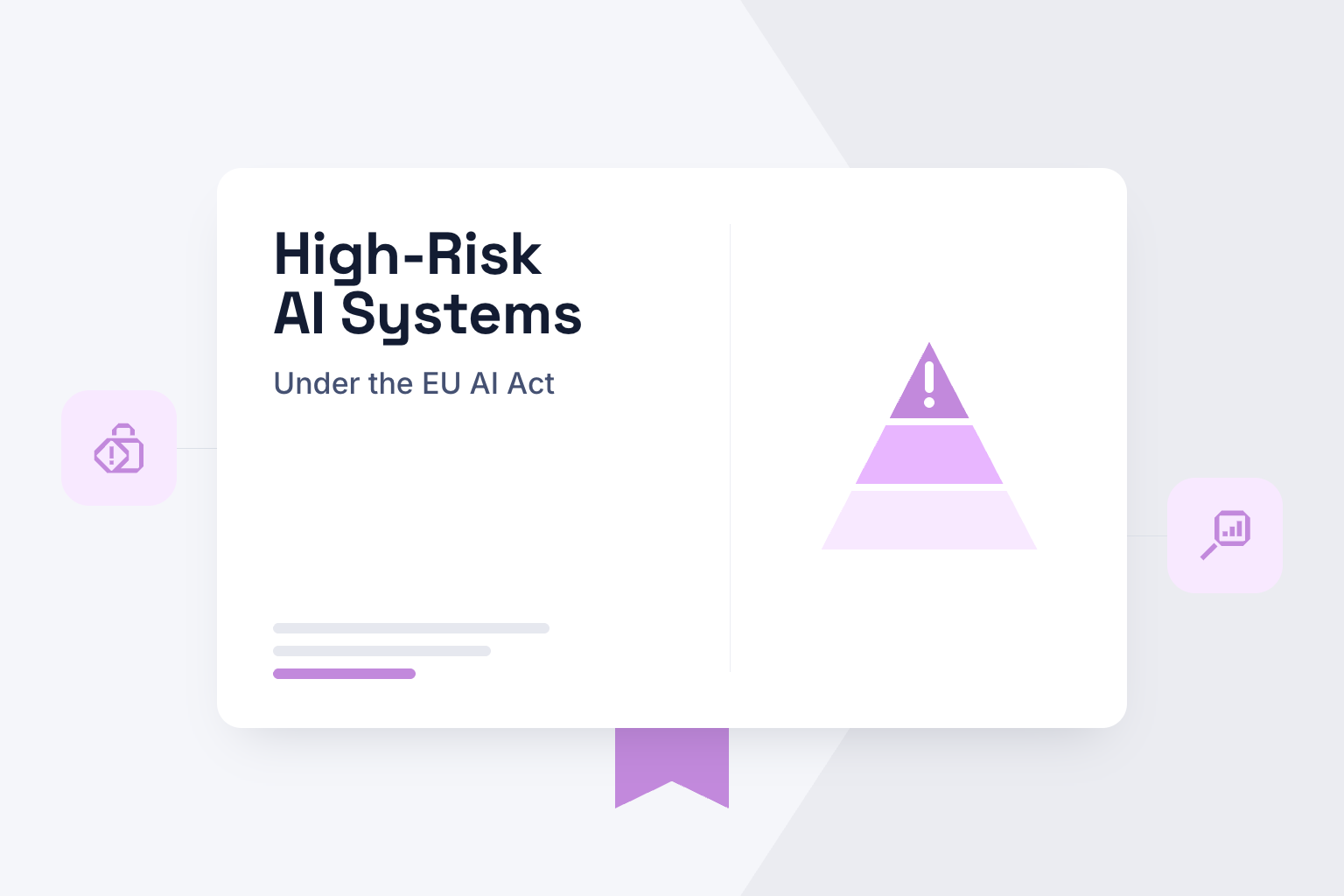
The EU AI Act regulates by risk rather than by technology. This is commonly described as four tiers, and that maps well onto the structure of the regulation: prohibited practices under Article 5, high-risk systems under Chapter III, systems carrying transparency obligations under Article 50, and everything else with no specific duties. The large majority of commercial AI sits in the lower two tiers. Because the work concentrates on the high-risk tier, classification is the first step in any AI Act programme.
When is an AI system high-risk?
Article 6 sets out two routes.
Route 1 (Article 6(1)): the system is intended to be used as a safety component of a product, or is itself a product, covered by the Union harmonisation legislation listed in Annex I, and that product must undergo a third-party conformity assessment. Both conditions have to be met. Medical devices and toys are the standard examples.
Route 2 (Article 6(2)): the system falls within one of the use cases listed in Annex III. This route captures most software and SaaS companies, so it is the focus here.
Route 1 changed in July 2026, and the change is easy to miss. Regulation (EU) 2026/1744 takes AI embedded in products governed by the Machinery Regulation outside the direct scope of the high-risk rules, and narrows the definition of a safety component so that AI used purely for performance optimisation, convenience or quality control does not become high-risk simply by being embedded. Medical devices and toys remain fully in scope. If you have seen machinery listed alongside medical devices as a high-risk example, that guidance predates the amendment.
The eight Annex III areas
Annex III is an exhaustive list of use cases. What matters is the function the system performs, not the industry it sits in. The table below summarises the eight headings and the carve-outs that appear expressly in the text.
The Article 6(3) exemption
A system in an Annex III area is not high-risk where it does not pose a significant risk of harm to the health, safety or fundamental rights of natural persons, including by not materially influencing the outcome of decision making. That applies where any one of the following four conditions is met:
Two points get missed. First, an Annex III system is always high-risk where it performs profiling of natural persons, and the exemption does not apply. Second, the exemption is not a free pass. A provider who considers a system not to be high-risk must document that assessment before placing the system on the market under Article 6(4), is subject to the registration obligation in Article 49(2), and must produce the documentation on request. That registration duty was proposed for removal during the Digital Omnibus negotiations and survived, with a lighter process.
What applies if your system is high-risk?
You must demonstrate conformity before placing the system on the market and keep it conformant in operation. The requirements sit in Chapter III Section 2: a risk management system (Article 9), data and data governance (Article 10), technical documentation (Article 11), record-keeping (Article 12), transparency towards deployers (Article 13), human oversight (Article 14), and accuracy, robustness and cybersecurity (Article 15). Provider obligations in Section 3 follow, including a quality management system (Article 17), then conformity assessment (Article 43), the EU declaration of conformity (Article 47), CE marking (Article 48) and registration (Article 49).
For the full path to conformity, see our guide to EU AI Act compliance, and for the regulation in the round, the EU AI Act overview.
When do the obligations apply?
Two deadlines moved, and they moved by different amounts.
The stated reason for the deferral is that the harmonised standards providers need in order to demonstrate conformity were not going to be ready in time.
The extra runway is a deferral, not a reprieve. The obligations themselves are unchanged, and a risk management system, defensible data governance and auditable technical documentation do not come together in a few weeks. Classifying your systems remains the task to start now, not least because it determines how large the programme is.
Frequently asked questions
How do I know if my AI system is high-risk?
Ask two questions. Is the system a product or safety component under the EU legislation listed in Annex I that requires third-party conformity assessment? And does it perform one of the functions listed in Annex III? If either applies and no carve-out and no Article 6(3) exemption is available, it is high-risk. If the system performs profiling of natural persons, it is high-risk in any case.
What are the eight Annex III areas?
Biometrics; critical infrastructure; education and vocational training; employment, workers management and access to self-employment; access to essential private and public services, including creditworthiness and life and health insurance; law enforcement; migration, asylum and border control management; and administration of justice and democratic processes.
Is every system in an Annex III area automatically high-risk?
No. Annex III contains its own carve-outs, including biometric verification, financial fraud detection within creditworthiness assessment, and the verification of travel documents. Article 6(3) additionally exempts systems that pose no significant risk. The classification must be documented and the system registered regardless. Systems that perform profiling stay high-risk.
Does 2 August 2026 still apply to high-risk AI?
No. Under Regulation (EU) 2026/1744, in force since 27 July 2026, high-risk obligations apply from 2 December 2027 for Annex III systems and from 2 August 2028 for Annex I systems. 2 August 2026 does still apply to the Article 50 transparency obligations, which were not deferred.
Was the whole EU AI Act postponed?
No, and this is the most common misreading of the amendment. Only the high-risk obligations moved. The Article 5 prohibitions have applied since February 2025, the general-purpose AI model obligations since August 2025, and the Article 50 transparency obligations from August 2026. The architecture of the regulation, its risk-based approach and its governance structure are unchanged.
What does the amendment mean for AI in machinery?
AI embedded in products governed by the Machinery Regulation falls outside the direct scope of the EU AI Act's high-risk rules. The Commission can, however, impose AI-specific health and safety requirements through delegated acts under the Machinery Regulation. Medical devices and toys remain within the AI Act.
See how Kertos inventories your AI systems, classifies them and prepares you for the high-risk obligations: Book a demo.
Legal status: 2 August 2026. This article is based on Regulation (EU) 2024/1689 as amended by Regulation (EU) 2026/1744. It is general information and does not replace legal advice on individual cases.