Compliance as a service is a new answer to a question every growing company eventually asks: who is actually going to do all this work? For years, you had two choices. You could buy software and run your compliance program yourself, or you could hire consultants and pay for their time. A third model is now taking shape, and it changes the deal entirely. A provider pairs AI with certified people, takes over the work, and sells you the finished result. If you've read about how AI and expert knowledge are changing compliance automation, this is where that story leads.
The shift reaches far beyond compliance. Across professional services, from legal work to accounting, a new kind of firm is appearing. These firms build their own technology, let AI handle the repetitive parts of the job, and put qualified professionals in charge of every decision that requires experience. Their customers buy the work, done. The industry has started calling this "services as software," a play on the SaaS model it is turning on its head.
Meanwhile, the pressure on compliance keeps rising. NIS2 has pulled thousands of new companies into scope, and the directive makes management personally accountable for cybersecurity, as you can read in the official text of the directive. Enterprise customers ask for ISO 27001 before they sign. The EU AI Act adds another layer. For most teams, compliance feels like a treadmill that speeds up every year.
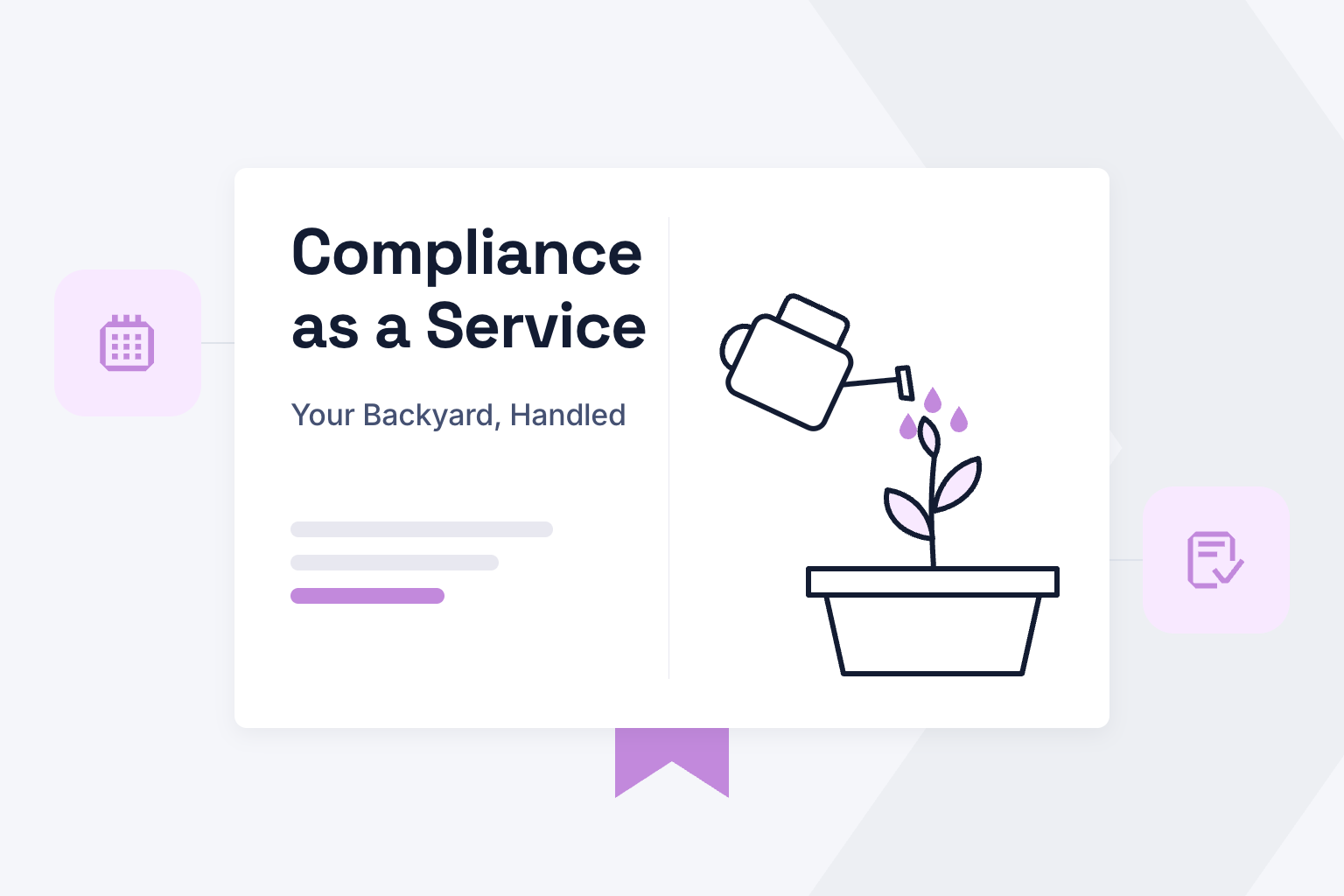
This guide explains what compliance as an outcome means, how it compares to the ways you may be handling compliance today, and what it looks like in practice. To get there, we'll start somewhere unexpected: in a backyard.
A Story About a Backyard and Five Ways to Look After It
There are five ways to keep a large garden in shape, and each one trades money, time, and quality differently. The same five options exist for compliance, which makes the garden a useful place to think.
Picture yourself moving into a house with a big backyard. There's a lawn, a long hedge, flowerbeds, and a few fruit trees. It looked wonderful at the viewing. Now it's spring, everything grows at once, and the garden needs attention every single week. You have five options.
Option 1: Do everything by hand
You buy a weeding sickle, a spade, and a pair of secateurs. The tools are cheap. The real cost is your weekends. Progress is slow, your back hurts, and by the time you've finished the front lawn, the back lawn needs cutting again. You also learn everything the hard way, like discovering in August that you pruned the roses at the wrong time.
Option 2: Buy better tools
You upgrade to a proper lawn mower and an electric edge trimmer. Things move faster, and the garden looks tidier. You spent more money, though, and you're still the one pushing the mower every Saturday. You still need to know how short to cut the grass in a dry July and when the hedge can take a hard trim. The tools speed up the job, and the job stays yours.
Option 3: Automate it yourself
You invest in a robot mower and an automated watering system. In theory, the garden now looks after itself. In practice, the robot gets stuck under the hedge, the sprinklers run during a thunderstorm, the edges stay ragged, and nobody prunes the trees. You've spent a lot of money and become the maintenance crew for your own machines. When you want to plant a new vegetable patch, the system can't adapt, and the results swing from fine to frustrating week by week.
Option 4: Hire a gardener
A professional gardener comes over and does the work by hand. The results are good, because this person knows what they're doing. Every hour of weeding and mowing shows up on the invoice, and a big garden takes many hours. Between visits, the weeds return. You're paying for time, and the garden is only as good as the last visit.
Option 5: Hire a gardening service that brings its own automation
Then there's a fifth option. A gardening service arrives with robot mowers, smart irrigation, and soil sensors it owns and maintains. A skilled gardener supervises everything, checks the results, and handles what no machine can, like shaping the hedge or deciding what to plant where. The service keeps its tools up to date and gets more efficient every season, and that efficiency shows up as a lower price for you. You agree on the result: a garden that looks great all year. That's what you pay for.
Most people who could choose option five would choose it without thinking twice. Compliance offers exactly the same choice.
From Backyard to Business: Five Ways to Manage Compliance
Each gardening option has a direct counterpart in compliance management. Most companies today sit somewhere between options one and four, often without realizing a fifth exists.
1. Spreadsheets, emails, and scattered tools
Policies live in a shared drive. The risk register is a spreadsheet last updated before the previous audit. Evidence gets chased by email, one screenshot at a time. On paper this approach is cheap, and in reality it eats hours from your best engineers, your operations lead, and often a founder. Few teams ever calculate the real cost of manual compliance, and it's usually higher than they expect. This is the sickle and the spade.
2. Compliance software that leaves the work with you
Many tools promise automation and then hand you a long list of tasks. Integrations collect some evidence and templates help with policies. Interpreting the requirements, writing documents that reflect how your company really works, and making risk decisions still land on your team. The gaps show up later: auto-generated documents that don't match reality, controls marked green that an auditor can't verify, findings that need untangling under time pressure. This is the lawn mower. Faster, and you're still pushing it.
3. Do-it-yourself automation
Engineering-led teams often build their own setup. A few scripts, some AI agents connected to the cloud environment, a workflow tool gluing everything together. It feels exciting at first. Then an API changes, an agent invents a control description, the person who built it moves to another project, and someone has to review every output anyway. You now maintain a second product that nobody planned to build. This is the robot mower stuck under the hedge.
4. Traditional consulting
Consultants bring real expertise and can deliver a solid project. They also bill by the day, and their work usually centers on a single point in time: getting you through the next audit. Once the certificate is on the wall, the engagement ends and the program slowly decays until the next cycle starts. Anyone who has worked toward ISO 27001 certification this way knows the pattern well. This is the gardener who bills every hour.
5. Compliance delivered as an outcome
The fifth option is the one Kertos was built for. A platform automates the repeatable work in the background, and certified experts take ownership of your program, from the first setup to the audit and through every month after it. You pay for being compliant and staying compliant. This is the gardening service that brings its own automation.
What Compliance as an Outcome Means
Compliance as an outcome means you buy a working compliance program, a passed audit, and a continuous state of compliance. The provider brings the technology, the people, and the responsibility for getting there.
To see why this model works now, it helps to split compliance work into two kinds. The first kind follows rules. Mapping controls to a framework, collecting evidence, drafting policies from established structures, checking cloud configurations against requirements, sending reminders, and tracking deadlines all fall into this group. The second kind requires judgment. Deciding the scope of your ISMS, setting your risk appetite, answering an auditor's tricky follow-up question, or assessing whether a data breach must be reported all belong here.
AI has become very good at the first kind of work. It reads requirements, compares them with your setup, and produces structured output at a speed no human team can match. The second kind still needs experienced people who carry responsibility for their decisions. Compliance as a service puts both under one roof, with one provider accountable for the result.
The incentives change too. In the tool model, every improvement in AI is something your team has to learn, configure, and supervise. In the outcome model, every improvement makes your provider faster and more accurate, and you benefit without lifting a finger. A consultant paid by the hour earns more when the work takes longer. A provider paid for the outcome does better when the work runs efficiently, which puts both sides on the same page.
One honest note: an outcome model still involves you. You own your business risks, you make the final calls on how your company operates, and some controls, like enforcing multi-factor authentication or running security awareness training, happen inside your organization. The difference is that someone qualified prepares those decisions, guides the implementation, and follows up, so your team spends its time on the few things only it can do. If you want to see what that looks like for a specific framework, our guide on NIS2 requirements shows which tasks stay with management and which can be handed over.
Defining the Outcome: What You Actually Get
In compliance, the outcome is a living, audit-ready program that runs continuously. It covers everything from organized data at the start to a passed audit and the months and years that follow.
Centralized, structured compliance data
Every outcome starts with order. Your assets, systems, vendors, risks, policies, controls, and evidence sit in one structured source of truth, connected to each other and kept current automatically through integrations with your cloud and business tools. When someone asks "which systems process customer data?" the answer takes seconds to find. This foundation is what makes the rest of the program work.
A workspace your auditor can use directly
Auditors spend a large share of their time hunting for information. With compliance as an outcome, they get access to a dedicated view where controls, evidence, and documentation are already linked and labeled. Questions get answered in context, and nobody digs through email threads. Audits become shorter and calmer, which you'll notice in your team's mood during audit week.
Audit preparation and a successful audit
The outcome includes the path to certification, planned and managed for you. Your program is implemented on the platform, a certified expert maps the route to the audit, and weak spots get fixed before the auditor ever sees them. Internal reviews, document checks, and preparation for auditor interviews are part of the package. The milestone you're paying for is a passed audit, whether that's for ISO 27001, NIS2, GDPR, or another framework.
Continuous managed compliance
The certificate is a milestone along the way. What matters afterward is staying compliant while your company grows, hires, changes vendors, and ships new features. In a managed compliance program, a lot happens in the background:
- Controls are monitored continuously, and drifts trigger alerts before they turn into findings.
- Risks are reviewed and updated as your business changes.
- Policies come up for review on schedule, with drafts already prepared.
- Employees receive reminders for training and acknowledgments.
- New vendors are assessed, and records of processing stay current.
- Recurring tasks for the next surveillance audit are planned and tracked.
You see the state of your program at any moment, and you're only pulled in when a decision needs you.
Named, certified people accountable for the result
Finally, the outcome includes people. Certified experts know your company, sit on your side of the table, and can formally take on roles such as your information security officer or data protection officer. That accountability is what turns software output into a result you can rely on.
How Kertos Delivers Compliance as a Service
Kertos delivers compliance as a service by pairing an agentic compliance platform with certified experts who work on your side. The platform handles the routine work, and qualified people own every judgment call.
The platform: automation that works in the background
The Kertos platform connects to your systems, collects evidence automatically, maps your controls across frameworks, and keeps your documentation current. At its center is KAIA, our virtual CISO. KAIA's agents prepare policies, analyze risks, and flag issues long before they reach an auditor. Because Kertos builds and maintains this technology itself, every improvement reaches your program automatically. You never have to migrate, retrain, or rebuild.
The certified experts: people who carry responsibility
Technology alone doesn't pass audits. Our certified experts are information security and data protection professionals who guide your program and stand behind it. For companies that need a formally appointed security lead, Kertos provides an external CISO: a certified expert who takes on the role, represents your security program to management and auditors, and keeps it moving every month. This is a real person in the seat, supported by KAIA and the platform.
The same applies to privacy. Under the GDPR, many companies must appoint a data protection officer, as set out in Articles 37 to 39 of the regulation. Kertos offers an external data protection officer who handles data subject requests, reviews processing activities, advises on new projects, and supports you when incidents happen. Combined with automated GDPR management, your records of processing, DPIAs, and vendor assessments stay current without spreadsheet marathons.
How it comes together in practice
Here's what a typical cycle looks like with Kertos:
- Onboarding: we connect your systems, import what already exists, and agree on scope and goals with you.
- Implementation: KAIA drafts policies and maps controls, while your certified expert reviews everything and adapts it to how your company works.
- Audit preparation: your certified expert prepares your team, closes open points, and gives the auditor a structured workspace.
- The audit: we stand beside you during the audit and handle follow-up questions.
- Continuous compliance: monitoring, reminders, reviews, and support from certified experts keep the program alive until the next audit cycle and beyond.
The results speak for themselves. Kertos customers pass their audits at a 100% rate, spend around 80% less effort on compliance, and rate our support at 98% satisfaction. AskUI, for example, reached ISO 27001 certification in 8-10 weeks, and you can find more examples in our customer success stories.
Services as Software: The Bigger Shift Behind Compliance as a Service
Services as software describes companies that sell finished work, delivered by AI and professionals together, where they used to sell tools for people to operate. Compliance is one of the fields where this model fits best.
Why the seat-based model is running out of road
For two decades, software grew by selling seats. The logic was simple: your company hires more people, those people need more licenses, and the vendor grows with you. That logic assumes your people do the work and the software helps them. Once AI can do a large share of the work itself, buying more seats for more people to operate more tools makes less sense. Businesses have noticed, and so have the companies selling to them.
There's also a budget question. Companies spend several times more on services than on software. For every euro that goes to a software license, roughly six go to the people and firms who do the actual work. Services as software goes after that larger budget by delivering the work itself, at software-like efficiency.
Why traditional firms struggle to make the switch
Established service firms have deep expertise, and adding AI tools to their workflows does make individual consultants faster. Their business model, though, still runs on the billable hour. When the work gets faster, revenue shrinks, so the incentive to automate stays weak. Engineers are rarely part of the core team, and few firms build real product. The new model comes more naturally to companies designed from the start around technology and expertise working together.
What makes compliance ready for this model
Some fields suit services as software better than others. The best candidates have work that is heavily rule-based and well documented, outputs that can be checked and audited, a clear definition of done, and a shortage of qualified specialists. Compliance meets every one of these conditions. Regulations and standards spell out the rules. Auditors verify the result. A certification or a clean surveillance audit marks success. And experienced information security and privacy professionals remain hard to hire.
That combination explains why compliance teams feel the pressure so sharply today, and why the outcome model gives them such clear relief. If you manage several frameworks at once, you've probably felt the overlap firsthand, which is why harmonizing a multi-framework compliance program becomes so much easier when one provider owns the whole picture.
What this means for buyers
For you as a buyer, the most important change is where the risk sits. When you buy a tool, you carry the risk that your team uses it well, that it keeps up with new requirements, and that the output survives an audit. When you buy an outcome, the provider carries that risk. You judge the provider on one thing: whether you're compliant.
The Future of Compliance
Compliance is heading toward a continuous, always-on state, run by AI agents and supervised by certified people. Audits will increasingly confirm what everyone can already see.
Picture your company a few years from now. A new regulatory requirement is published, and within days it's mapped against your existing controls, with the few real changes already drafted for review. Your cloud configuration is checked every day, and a misconfigured storage bucket is flagged and fixed long before an auditor could ever spot it. A prospect sends a 200-question security questionnaire on Monday, and the completed answers sit in your sales team's inbox the same afternoon.
The threat landscape won't slow down. European agencies track thousands of significant incidents every year, and attackers adapt their methods constantly, as this analysis from the EU's cybersecurity agency shows. Keeping pace takes continuous monitoring, handled by agents and reviewed by people.
Regulation will keep expanding too. The EU AI Act introduces new governance and documentation duties for companies that build or use AI, and its obligations take effect in stages, as described in the text of the regulation. New standards such as ISO 42001 add management systems for AI. Companies that run compliance as a continuous outcome will absorb these changes as updates to a living program. Companies still running it on spreadsheets will face another project every time.
In this future, the human role grows more valuable. Certified experts spend less time collecting screenshots and more time advising management, assessing real risks, and helping leadership meet duties such as the personal accountability described in our NIS2 checklist for managing directors. Compliance moves from a back-office chore to a business asset: something that shortens sales cycles, builds trust with customers, and lets founders sleep well.
How Kertos Is Leading the Shift to Compliance as an Outcome
Kertos was built for this model from day one. We're a compliance company that develops its own technology, and our platform and our certified experts grew up together.
That shapes everything we do. Our engineers and our certified experts work on the same team, so every hour a certified expert spends on a customer program teaches the platform something new. When a certified expert notices a task that keeps repeating, it becomes automation. When KAIA prepares something, a certified expert reviews it before it reaches you. The result gets better and faster with every cycle, and you feel that improvement without paying more for it.
We're also European by design. Kertos is made in Germany, our data is hosted on European infrastructure, and our certified experts know European regulation from the inside, from GDPR and NIS2 to the EU AI Act. For European companies, that means a provider who understands the regulatory context they operate in, speaks their language, and keeps their data where it belongs.
Finally, we take responsibility. Kertos customers get a platform, a named certified expert, and, where needed, an appointed external CISO or external DPO. Our goal is what we call continuous compliance as a service: a program that passes audits, stays current, and quietly runs in the background while your team builds your business.
The Benefits of Compliance as a Service at a Glance
Here's a short summary of what compliance as an outcome gives your company:
- A clear result to pay for: an audit-ready program and continuous compliance, with certified experts accountable for getting you there.
- Far less internal effort: around 80% less work for your team, because automation and certified experts take over the routine.
- Audit success: structured preparation, a dedicated auditor workspace, and a 100% audit pass rate across Kertos customers.
- Continuous compliance: monitoring, reminders, reviews, and background automation that keep your program current between audits.
- Formal roles covered: an external CISO and an external DPO, appointed and working as part of your team.
- Technology that keeps improving: every advance in the platform reaches you automatically, with no migrations or retraining.
- One program across frameworks: ISO 27001, NIS2, GDPR, SOC 2, TISAX, and more, managed together, so work done once counts many times.
Frequently Asked Questions About Compliance as a Service
What is compliance as a service?
Compliance as a service is a model where a provider takes over the work of building and maintaining your compliance program and delivers the result: an audit-ready program, passed audits, and continuous compliance. At Kertos, this combines an agentic platform with certified experts.
How does it compare to compliance software?
Compliance software gives your team tools to do the work. Compliance as a service delivers the work itself, using automation and certified experts, so your team only contributes the decisions and actions that must come from inside your company.
How does it compare to hiring a consultant?
Consultants typically bill by the day and focus on one audit at a time. Compliance as an outcome covers the full cycle, including the months between audits, and uses automation to keep effort and cost down.
Do I still need someone in-house?
You need a point of contact who can make decisions for your company. Formal roles such as the information security officer or the data protection officer can be filled by an external CISO or external DPO from Kertos.
Which frameworks does Kertos cover?
Kertos covers ISO 27001, ISO 27701, ISO 42001, NIS2, GDPR, SOC 2, TISAX, C5, and the EU AI Act, and manages overlapping requirements across frameworks in a single program.
The Shift Has Already Started
Every service industry is facing the same moment. AI can do a growing share of the work, and buyers are asking why they should keep paying for hours and seats when they could pay for results. In compliance, that moment has arrived. You can keep pushing the mower yourself, babysit a robot that gets stuck under the hedge, or pay a gardener by the hour. Or you can hand the garden to a service that brings its own tools, keeps them sharp, and gets paid for a garden that looks great all year.
Compliance as an outcome gives you a program that passes audits, stays current, and runs while you focus on growth. It gives your team its time back and gives your customers a reason to trust you.
If you're ready to see what that looks like for your company, book a call with our team. We'll walk you through the platform, introduce you to the certified experts who would work on your program, and show you how quickly you can get audit-ready and stay that way.