
Key takeaways
- Large companies' supplier terms rarely say "certificate only"; they usually say "ISO 27001 or equivalent." Without a certificate, suppliers answer a new questionnaire for every customer instead, ranging from 17 yes/no statements to 627 questions in the SIG Core.
- Before the certificate, suppliers can show their customer three things: a confirmation from their consulting partner that an ISMS is being built to ISO 27001, first measures they document themselves, such as a policy, a risk register, and a supplier assessment, and a project plan with dates.
- As a guideline, Kertos plans around 19 weeks to build the ISMS. From project start to certificate, it takes around seven months; the certificate typically arrives four to six weeks after the Stage 2 audit.
- Answers in security questionnaires often become part of the contract. Deutsche Bahn sets a contractual penalty of 2% of the fee per breach of certain obligations in its security terms, capped at 5% in total.
- Most time in an ISO 27001 implementation is lost not to technology but to perfectionism, involving too many people too early, and unused AI tools. The most important lever within the standard is a scope that is narrow but honest.
Mid-sized suppliers that work with large customers in their supply chain can hardly avoid information security requirements today. In many industries they have long been standard.
Sooner or later, a requirement that matches ISO 27001 lands on your desk: as a demand for a certificate, as a questionnaire whose content such a certificate covers, or as a contract clause that sets exactly these requirements. Sometimes it comes with a clear deadline, such as "certificate within twelve months." Sometimes it is a criterion in a tender, and sometimes you only notice it when a competitor with a certificate wins the contract.
An information security officer I am currently supporting regularly receives security questionnaires from larger customers. Because the certificate is missing, she has so far answered with her company's technical and organizational measures and stated equivalent measures. Some tenders now require her company to meet its certification timeline.
Above all, your major customer wants to see that you have your risks under control, know your own suppliers, keep its data safe, and can keep delivering reliably even after a security incident. An ISO 27001 certificate can prove all of this, provided the relevant areas are within scope. Building an information security management system (ISMS) to ISO/IEC 27001:2022 through to ISO 27001 certification takes time, though, and many buyers want to see during the implementation which standards already apply at your company.
In this article, I show you how suppliers from manufacturing, mechanical engineering, electronics and automation, or raw materials and wholesale can bridge this time with their customer and bring their ISMS to certification in parallel.
Why are your customers asking for ISO 27001 right now?
For many of your customers, the security of their own supply chain is now a legal obligation, and they pass this obligation on to you through questionnaires and contracts.
Germany's NIS2 Implementation Act has applied since December 6, 2025. Affected companies must explicitly ensure "supply chain security, including security-related aspects of the relationships with direct suppliers or service providers" (Section 30(2) sentence 2 no. 4 BSIG). By its own estimate, the German Federal Office for Information Security (BSI) now supervises around 29,500 entities instead of the previous 4,500 or so, and each of them has to assess its suppliers.
Austria has had a comparable regulation since October 2026 (NISG 2026, BGBl. I No. 94/2025), and Swiss suppliers receive the requirements through their contracts with EU customers.
Then there is the risk itself. In around 28% of companies in Germany, a supplier was confirmed or suspected to have been affected by data theft, sabotage, or espionage in the twelve months before the survey (Bitkom, Wirtschaftsschutz survey 2025). For your customer, that makes you a possible point of entry. What regulated customers ask of suppliers that are not covered by NIS2 themselves is described in our article on NIS2 in the supply chain.
One exception up front: if you supply the automotive industry, you will usually be asked for a TISAX label rather than an ISO certificate. ISO 27001 does not normally replace TISAX there.
What exactly does your customer require: a certificate, a questionnaire, or a contract clause?
In most cases, it is a mix of all three. Large companies' supplier terms rarely say "certificate only"; they say "ISO 27001 or equivalent." The certificate is simply the easiest proof. Without a certificate, you answer questionnaires instead, and a new one for every customer.
How extensive are these questionnaires?
That depends heavily on who is asking. An example from the German Mittelstand: the Krah Group has its IT service providers answer 17 statements with yes or no in a self-assessment. It asks, for example, whether there is a security policy, whether employees are trained, whether backups exist, and whether the provider checks its own suppliers. Anyone who answers no to one of the particularly important statements or to four of the others must submit an action plan; otherwise, the Krah Group will not exchange data with them (Krah Group, supplier self-assessment for IT service providers, form F10-0-6).
Common standard questionnaires are much longer: the SIG (Standardized Information Gathering Questionnaire) from the US association Shared Assessments has 627 questions in its Core version and 1,936 in the full version (Shared Assessments, SIG 2025). Corporations such as Siemens, BASF, and Deutsche Bahn also regulate the topic in their own contract terms on cybersecurity.
In terms of content, the questionnaires are very similar. Typical questions are:
- Who is responsible for information security at your company?
- Are there approved policies, risk management, and an inventory of your systems?
- How is access protected, for example with multi-factor authentication?
- Are backups tested regularly?
- How quickly do you report a security incident?
- How do you check your own suppliers?
- Are your employees trained regularly?
Do not underestimate the answers, as they often become part of the contract, even if an AI tool prefilled them. Deutsche Bahn sets a contractual penalty of 2% of the fee from the affected contract per breach of certain obligations in its security terms, capped at 5% in total (Deutsche Bahn AG, supplementary contract terms for information security, edition 01.11.2024, section 1.6). Even Amazon does not require a certificate in its Vendor Security Policy, but it expects suppliers to report a security incident no later than 24 hours after they become aware of it (Amazon, Vendor Security Policy, as of September 11, 2024).
What does a certificate change?
It saves you a large share of the questions. In my projects at Kertos, I often see exactly this turning point: the answers are scattered across Excel files, every customer asks in its own format, and at some point the question arises whether it would be better to get certified right away. Spoiler: yes!
And in tenders?
In public tenders, the contracting authority decides itself which proof of suitability it requires (Section 122 GWB). ISO 27001 quickly becomes a knockout criterion because it is the easiest proof. A customer from one of my projects called ISO 27001 an "exit criterion" in almost every tender it takes part in. And if a competitor already has the certificate, it gets through the preselection without additional questions.
So everything points to certification as the next logical step. The decision has been made; even so, months can pass before you actually hold the certificate in your hands. So what happens now?
What can you show your customer before the certificate?
As long as the certificate is missing, your customer mainly wants to see that you are making visible progress and are serious about the goal. There are three ways to show this: a confirmation from your consulting partner that you are working on an ISMS, first measures you have implemented and document yourself, and a credible project plan. Early evidence buys you time, but of course it does not replace the certificate.
What does a confirmation of collaboration achieve?
At Kertos, we offer to issue a so-called confirmation of collaboration when needed. In it, we confirm that your company is building an ISMS to ISO 27001 together with us and which areas are currently being worked on. If your customer asks, we also state a planned time frame for the certification audit. However, the confirmation deliberately does not certify an implementation status, and it does not replace an audit. That is why it says "is being developed and built step by step" and never "has been implemented." Customers often need such a letter at very short notice, for example for a tender.
In my projects, this is common practice: several customers asked me for this confirmation right at the start of our collaboration and passed it straight on to their own customers.
Which measures can you document yourself?
What has already been implemented, you document yourself. Many points from the questionnaires can be evidenced early in the implementation, with reference to the clauses of the standard and the Annex A controls:
- Scope and policy: a documented scope and an approved information security policy (ISO/IEC 27001:2022, clauses 4.3 and 5.2).
- Responsibility: a named information security officer and documented responsibilities (ISO/IEC 27001:2022, clause 5.3).
- Risks: an inventory of your assets and a risk register with a treatment plan (ISO/IEC 27001:2022, clauses 6.1.2 and 6.1.3).
- Suppliers: a list of your own suppliers with an assessment of the critical ones, so that your own ability to deliver is secured as well (ISO/IEC 27001:2022, Annex A 5.19 to 5.22).
- Training: evidence that your employees have been trained and made aware of information security, for example with a participation rate (ISO/IEC 27001:2022, clauses 7.2 and 7.3 and Annex A 6.3). Our customers run their training directly on the Kertos platform, so the evidence is in one place.
The supplier assessment in particular is a plus. Almost one in three companies in Germany sets cybersecurity requirements for its suppliers, but only 6% check them regularly with audits (TÜV Association, TÜV Cybersecurity Study 2025, survey of 506 companies).
Not everything can be shown early, though. The internal audit, the management review, and the proof that your measures work over months and are actually lived only come toward the end of the project. At the start, this evidence does not exist yet, but you can schedule it and show it in a project plan.
When can your customer expect the certificate?
Of course, the certificate should be the goal sooner or later. So that your customer knows when to expect it, you also give them a credible project plan with dates. This is often a strong argument, and many customers even explicitly provide for it: supplier self-assessments often have a "certification planned on" field. Some customers accept an action plan, others agree on a transition period. In tenders, I often see wording like "certification commissioned with X, Stage 1 audit in month Y, certificate by Z at the latest."
Such a project plan is not only a guide for your customer. It is also the foundation of your own path to the certificate and gives structure internally.
How do you plan the implementation realistically?
Work backward from your desired audit date. As a guideline, we at Kertos plan around 19 weeks to build the ISMS up to audit preparation. This is followed by the internal audit and management review, and around three weeks later by the external certification audit, which runs in two stages (Stage 1 and Stage 2). From project start to certificate, you should expect around seven months.
In principle, the implementation can be divided into phases that every company goes through on the way to the certificate. The times are guideline values from our project plan, not fixed requirements:
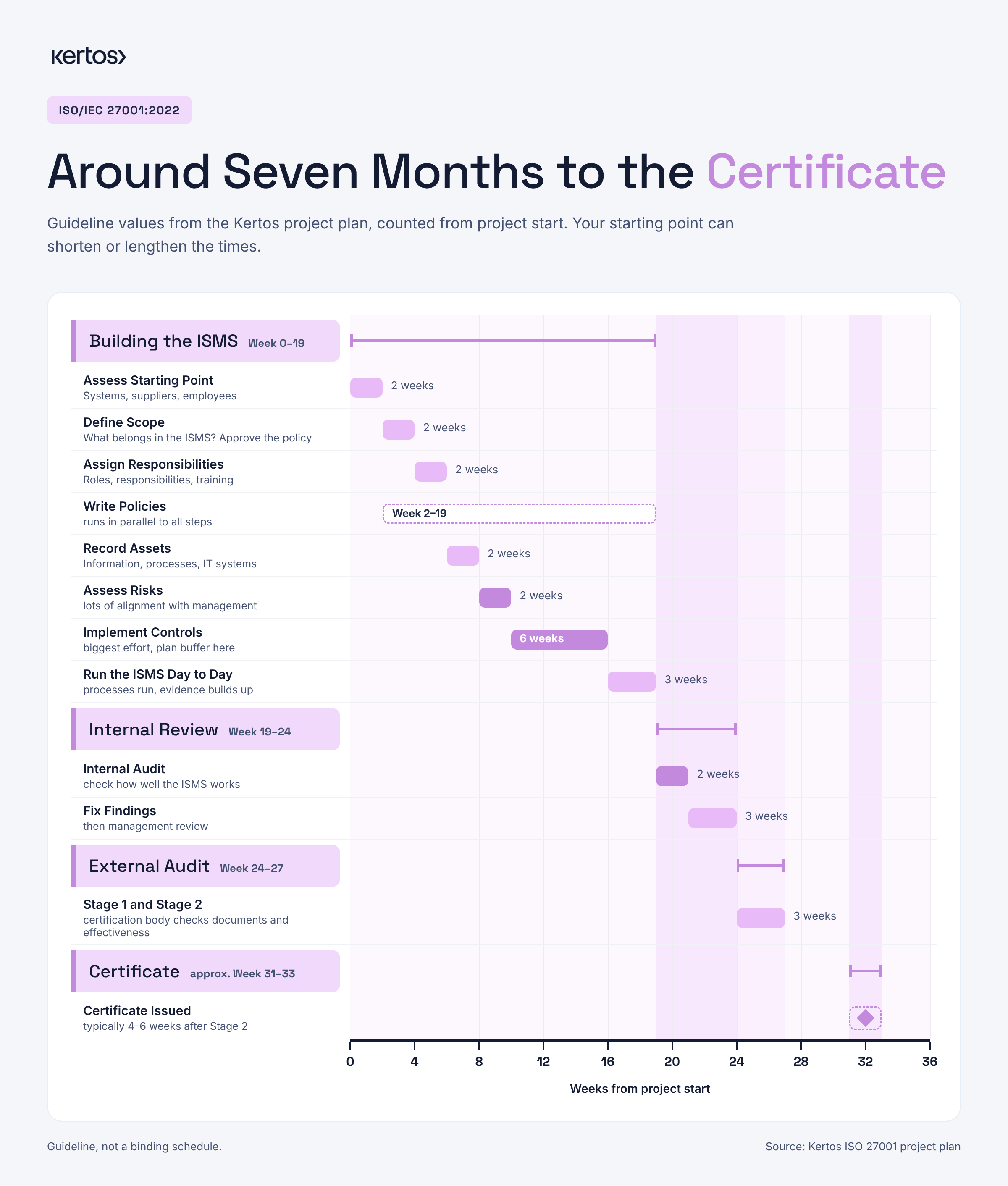
You adapt the policies in parallel over the entire period. You need the biggest buffer for risk treatment. The certificate typically arrives four to six weeks after Stage 2.
The times in the graphic are, of course, averages. How long the implementation takes for you depends on very different factors. Some of them speed you up, others slow you down.
How can you save time in the implementation?
There are two kinds of levers: internal factors you control yourself, and levers that come from the standard itself. The most important lever within the standard is the scope.
Which internal factors play a role?
How quickly the implementation succeeds depends on many individual factors that we, as outside experts, can hardly see in advance. The most important ones fall into four categories:
- Capacity: How much time do the people involved have alongside day-to-day business? Are more urgent projects running in parallel that take priority?
- Decision paths: How quickly does management decide? Does your information security officer have the authority to decide alone, or do they have to align everything with management? The larger the company, the more people and departments are involved and the longer these paths become. Before a procedure for a measure in the standard is introduced, such as granting access rights, the sites often first have to clarify how it works today. Then management decides which process works across the company and approves it. After that, it goes back down through the departments until it is lived. That can take a very long time.
- Starting point: Which processes, documents, and IT security measures already exist? Does everyone know right away where everything is, or do they first have to search and ask around?
- Know-how and AI: Does your team have experience with ISO standards, for example from an existing ISO 9001? And above all: how confidently does it work with AI tools? For me, AI is now an integral part of a modern ISMS implementation, not an add-on. Companies with an AI infrastructure and people who can use it have policies adapted to their own company, questionnaires pre-answered from existing documents, and evidence structured. That is what makes a lean implementation alongside day-to-day business possible in the first place.
An example from my projects: a mid-sized company with several sites in Germany and one in East Africa wanted to decide, as part of physical security, whether to monitor its offices with cameras. Before that was possible, the East African site first had to clarify: Are the prerequisites in place? Who is responsible there? Does local law permit video surveillance, and are the necessary permissions in place? And does the office landlord perhaps have conditions that rule it out? Each of these questions costs time before the measure can even be tackled.
What role does the scope play?
Besides these internal factors, there are of course strategic and technical decisions that strongly influence the effort. The most important one concerns the scope: it defines which companies, sites, processes, and systems your ISMS covers. You set it at the start within the clauses on establishing the management system (ISO/IEC 27001:2022, clause 4.3), and it frames everything else.
You need to keep two things in mind. The scope must cover the service you provide to your customers, as well as all processes involved in or affecting the delivery of that service. That is exactly what your customer checks on the certificate. And the scope must be honest: you have to be able to justify anything you exclude.
Typical adjustments are:
- Legal entities: If your group has several legal entities, not all of them have to be in scope from the start. You can start with one entity and add others later. Separate certification is worthwhile above all when the IT is separate too.
- Sites: A site where none of the covered processes take place, such as a pure warehouse without its own IT, can stay out. That saves effort in the implementation and in the audit.
- Offices: Excluding an office from the scope can make sense, especially if your company works mostly remotely or only rents space in coworking spaces or shared offices. If there are only a few monitors there and no data carriers or documents are stored, the office is less relevant for information security. You do have to be able to justify the exclusion, though.
For all the savings potential, the certificate should still fit your other business goals and your strategic development in the long term, for example when new legal entities, sites, or markets are added.
Where do companies lose the most time?
Rarely on technical measures such as backups, encryption, or access protection. In my projects, most time is lost to organizational hurdles. Three of them come up again and again.
- Getting lost in details. Many teams want to word every policy perfectly and implement every measure completely before taking the next step. Perfection is not necessary for the initial certification. Use templates, adapt them to your company, and make decisions that are good enough for the start. You can improve later in ongoing operations.
- Involving too many people and departments too early. When everyone has a say from the start, long alignment loops follow. Start with a small core team of the information security officer, IT, and one contact person in management. Bring in specialist departments specifically when their topic comes up.
- Not using AI efficiently. AI tools can adapt policies to your company, draft process documentation, or structure evidence. Teams that do not use them write a lot by hand. You still have to check the results, because in the audit and toward your customer, you stand behind every statement.
What is your concrete roadmap when your customer sets an ultimatum for an ISO 27001 certificate?
An ultimatum from your main customer can feel overwhelming at first, especially when it concerns one of your most important supply relationships or a decisive contract. But there is no need to panic. There is a realistic roadmap for such cases:
- Make the decision to get certified. Bring in a suitable partner to support you.
- Have the collaboration confirmed early. Pass the confirmation on to your customer. Document first implemented measures such as the policy, the risk register, or the supplier assessment yourself and add them.
- Develop a concrete, well-founded project plan. It should take your internal resources and the levers from the standard into account so that the implementation stays efficient and lean. Which phases are critical in your industry? If the fourth quarter is particularly tight for you, do not schedule the audit there. And when will key people be away for longer periods?
- Start the implementation. The motto here is: as narrow as possible, as broad as necessary. Do not aim for perfection. That is what the years after the initial certification are for: with every annual surveillance audit, you can work further toward your ideal.
- Take care of audit dates and the certification body early. By when do you want to be certified? Are there certification bodies you should approach early because of language, industry, or focus? What lead times do they have? And what does that mean for your internal audit: when and with whom will you carry it out?
- Trust your expertise. Keep your customer informed about your progress.
How does Kertos support suppliers on the way to ISO 27001 certification?
Kertos is a European compliance platform on which you build your ISMS to ISO 27001. Scope, policies, risk register, supplier assessment, and evidence are all in one place. When the next questionnaire arrives or your customer asks about your status, the evidence is already structured. The "Information Security Basics" training is included in the platform, in German and English. Completion is recorded per employee as evidence in the ISMS.
Certified experts from Kertos support you from the project plan to the certification audit. If your customer needs evidence during the project, Kertos issues a confirmation of collaboration that names the setup of your ISMS and, on request, the planned time frame for the certification audit. Implementing the measures stays with you; Kertos structures, documents, and supports. So far, every Kertos customer has passed their audit. We are happy to discuss what a realistic project plan looks like for your company in a personal demo.
Frequently asked questions
What can we show our customer while the ISO 27001 certificate is still missing?
Three things: a confirmation from your consulting partner that you are building an ISMS to ISO 27001, first implemented measures such as the policy, the risk register, the supplier assessment, and training records, and a project plan with dates up to the certification audit. You can only present the internal audit, the management review, and proof that the measures work over months toward the end of the project.
Is an ISO 27001 certificate in eight to twelve weeks realistic?
Only in exceptional cases. Our guideline is around 19 weeks to build the ISMS, followed by the internal audit, Stage 1, and Stage 2. It goes faster if the technology is already largely compliant with the standard, management decides quickly, and one person is dedicated to the project.
Do we need TÜV or DEKRA, or will any certification body do?
What matters is accreditation, not the name. In Germany, DAkkS accredits certification bodies; in Austria, Akkreditierung Austria; in Switzerland, SAS. Certificates from bodies accredited by other members of the international accreditation network, such as the UK's UKAS, are usually recognized as well (IAF Multilateral Recognition Arrangement). Ask your customer in advance whether they require specific bodies. The certificate is valid for three years, with annual surveillance audits in between.
Can we book the audit date while the project is still running?
Yes, and you should. In my projects, the waiting time at certification bodies is one to one and a half months on average, often longer in the fourth quarter. Work back from your project plan to the date and reserve it early.
Is a completed questionnaire enough instead of a certificate?
For many customers, yes, for a while, especially if you present a plan for certification. In the long run, though, it usually becomes more work, because every customer asks its own questions. That can quickly become inefficient and a real drain on your time.